


Kokrin
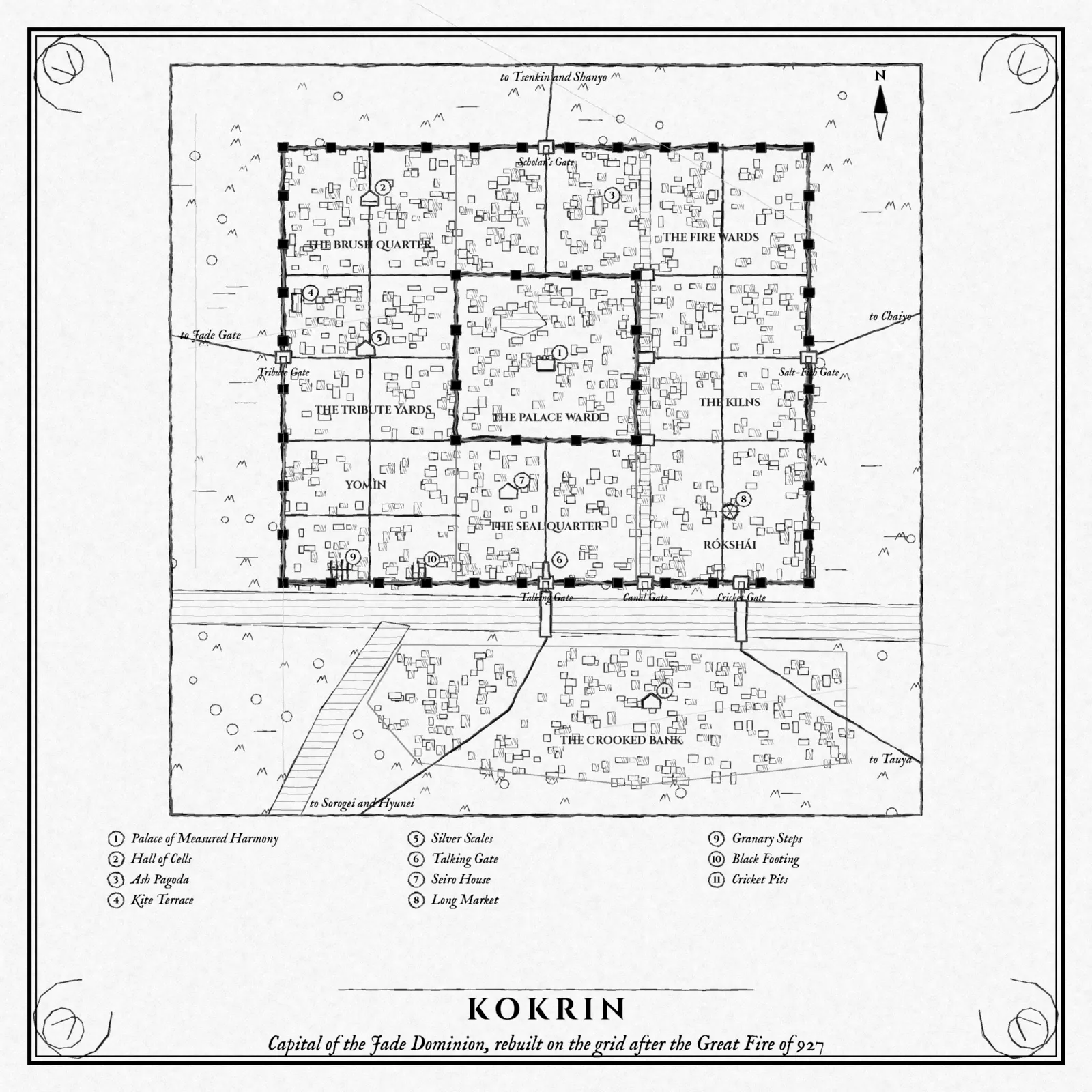
Capital of the Jade Dominion of Kaishon · about 1,100,000 people
You see the kites first. Travelers on the road from the Jade Gate, ten days behind them at a cart's pace, mark them over the paddies long before the walls: red and black shapes tethered to the Kite Terrace, passing word down the line from the Rampart. Then the wall rises out of the flat rice country, rammed earth faced with gray brick, straight as a ruled line for six miles. At the Tribute Gate the air smells of river mud from the Tsanha, smoke from the state kilns on the far side of the city, and the steam of a million pots of rice.
Kokrin is the largest city in the world, and it sounds like it. Inside the gate the streets run dead straight toward the vermilion wall of the Palace of Measured Harmony, and every hour the drums of the fire towers answer one another across the grid, so that the whole city keeps one time. Porters call their loads by the counting word, clerks walk in pairs under paper parasols, and in summer the caged Muhau cicadas in the teahouse windows drown out all talk. Nobody in Kokrin gets lost, because the streets are numbered.
At a Glance
At a Glance
| Population | About 1,100,000: some 850,000 inside the walls, the rest on the Crooked Bank and in the river villages |
| Ruled by | Emperor Tokrai Shaiku (71), dying and rarely seen; in truth Grand Chancellor Seiro Makok, who has held the seals since 1143, and the ministries; a magistrate for each ward |
| Walls | Rammed earth faced with brick, about 40 feet high, six miles east to west and five north to south; six gates, one a water gate; the Palace Ward has its own vermilion wall |
| Water | The Tsanha along the south wall, the Shauho joining it at the southwest corner, a canal through the eastern wards, and a well or covered water jar on every block by law |
| Lives on | The ministries and the Examinations; silk, porcelain and lacquer from the state workshops; the rice barges; the Tsanha Crossing |
| Faith | The Doctrine of Ordered Reason in public; the Unseen Kin in almost every kitchen |
| Tongues | Kaishoni, written in Measures by officials and Reed-marks by everyone else who writes; Caelvennois among money-changers; Maved and some Cherüsh in the Tribute Yards |
| Coin | Gold mihomau, silver tsinkya, and paper notes for small sums, worthless outside Kaishon |
| Known for | The Palace of Measured Harmony, the grid, the Examinations, cricket fights, the tribute caravan |
| Direction | CONTESTED |
History in Brief
History in Brief
- 248 — Emperor Dezau Kokdau of the northern throne conquers the other two Thrones and founds the Jade Dominion. By local lore he made Kokrin, where the Shauho meets the Tsanha between the three old kingdoms, his seat because no throne had ever claimed it.
- 260 — The first examinations for office. They have been sat in Kokrin ever since.
- 341 — Tokrai Meksi begins the Long Rampart after steppe raiders sack Sorogei. The Tokrai have ruled from Kokrin ever since.
- 588–596 — The Reasoned Purge. Grand Chancellor Seiro Ketsan persuades the emperor to take up the Doctrine of Ordered Reason, and the city's temples are shut.
- 725 — The ministers cast down Emperor Tokrai Koimu for "negligence" and send him from the palace to Tsenkin.
- 927 — The Great Fire of Kokrin burns a third of the capital. The rebuilt city is laid out on the grid it keeps today.
- 928–958 (local lore) — The Clearing. The engineers cut the grid through the two-thirds of the city that did not burn. Laborers digging footings at the river corner find black stone under the mud.
- 971–975 — Kaishon begins paying the Cherüsh tribute. The yearly silver caravan sets out from Kokrin, and the ministers call it "gifts."
- 1019 — The head of the rebel Tsehei Yotoke is shown in Kokrin for a year.
- 1082 — The Cherüsh civil war begins, and the tribute stops.
- 1099 — Tokrai Shaiku takes the Jade Throne at 24. In his strong years he rebuilds the canals and opens the examinations again to the southern provinces.
- 1117 — Princess Tokrai Seitotai is born.
- 1139 — Seitotai, 22, sits the examinations under a false name and places third in the Dominion. The ministers burn her paper.
- 1141 — Sarsak Tolmar unites the Cherüsh, and the tribute caravan leaves Kokrin again.
- 1143 — The Emperor withdraws from sight, and Seiro Makok takes the seals of state.
- 1146 — The Emperor gives his daughter his seal, and his ministers take it back "for safekeeping."
The Layout
Kokrin is a rectangle on flat paddy land, its south wall on the north bank of the Tsanha, with the Shauho coming in from the southwest to join the Tsanha just b…
The Layout
Kokrin is a rectangle on flat paddy land, its south wall on the north bank of the Tsanha, with the Shauho coming in from the southwest to join the Tsanha just below the southwest corner. The Palace Ward sits at the exact center. The Palace Axis runs north and south through it and the Palace Cross east and west, four more great avenues cross the city, and the streets between them are counted, not named: a street is so many east or west of the Palace Axis, and a lane so many north or south of the Palace Cross, so an address is "Fourth East, Seventh South." People give the streets nicknames anyway, such as Eel Lane, Inkstone Row and the Hundred Stoves, and the magistrates do not write them down. A canal runs north from a water gate on the river through the eastern wards. The only crooked streets are across the river, on ground the wall never took in.
The Palace Ward. The vermilion wall of the Palace of Measured Harmony runs almost two miles on a side around halls, inner ministries, the Emperor's apartments, the pheasant parks and the lotus ponds. Some twenty thousand servants, clerks and guards live inside and seldom leave. No drum is beaten within the wall and no one raises a voice. Everyone who enters by its south gate must state his rank before his name, and a servant who forgets is sent away until he remembers.
The Seal Quarter. South of the palace lie the ministries of the outer court and the walled houses of the families who fill their posts, with the Seiro House in the middle. The streets are swept twice a day. The sound is the clatter of document carts and the scratch of brushes through open windows. At dusk the clerks leave in lines by rank, and a clerk who walks ahead of his superior is reported by the man behind him.
The Brush Quarter. The northwest wards belong to the Examinations: the Hall of Cells, the state academy, tutors' schools, paper-sellers, brush-makers, ink-grinders, and several hundred lodging houses that are half empty eleven months of the year and packed in Mèizûrûi. It smells of pine soot and wet paper. Every lodging-keeper can name the candidates who will fail.
The Fire Wards. The north and northeast of the city is where the Great Fire of 927 began. Rebuilt first and most strictly, it is the most crowded part of Kokrin: three-story brick tenement courts under tile, housing porters, laborers and conscripts' families, perhaps a quarter of a million people. The Ash Pagoda stands here. Every block keeps a water jar and a fire register. Its children play a game called Bucket Line, in which the slowest child is "the one who let it burn."
The Tribute Yards. Inside the Tribute Gate on the west side are the caravan yards, ox pens, carters' inns and customs sheds of the Tsanha Crossing. The Silver Scales and the Kite Terrace are here. Qaflan drivers, Nintang half-bloods and drovers who will one day join the Rampart Squatters wait for loads, and Maved is spoken as often as Kaishoni. The yards smell of dung and wet felt. The tribute's Cherüsh escort camps outside the gate, never inside.
The Kilns. East of the palace, along both banks of the canal, stand the state workshops: porcelain kilns, lacquer sheds and the imperial silk looms. Tens of thousands work in shifts called by drum. Lacquer gives new workers a rash on their hands that the old hands call "the Kilns' welcome." The silkworm houses are walled and guarded, because to carry the secret of rearing the Tsenkin silkworm out of the Dominion is a crime against the state.
Rókshái ("market"). The southeast wards between the canal and the east wall are the merchants' city, and everyone calls it by the plain word. The Long Market fills its central avenue, and the side streets hold rice brokers, money-changers, teahouses, pawnshops and the counting-houses of Chaiyo merchants who back the Open Gate party. It is the loudest quarter in Kokrin. A merchant here may be richer than a minister and must still step aside for any magistrate.
Yomìn ("harbor"). The southwest corner, where the two rivers meet, is the river harbor: quays, rice granaries, barge-yards, rope walks and the grain-tax warehouses. Barges come down the Tsanha from the Jade Gate, up it from Tauya, and down the Shauho from Sorogei, and the barge-towns of the Drift tie up here for the winter. Yomìn smells of tar and eel, and its people call the Doctrine's rules "upstream talk."
The Crooked Bank. Across the Tsanha, between it and the Shauho, sprawls the suburb the grid never reached: two hundred thousand people in crooked lanes of timber and bamboo, joined to the city by the bridges from the Talking Gate and the Cricket Gate. Tanners, dyers, butchers, pig-keepers and night-soil carriers live here, among the cheapest teahouses and the worst gambling houses. Thatch is still allowed, and something burns here almost every year. Its people are proud that no one has ever numbered their streets.
Landmarks
The Palace of Measured Harmony. The palace is the vermilion-walled seat of the Jade Throne.
Landmarks
The Palace of Measured Harmony. The palace is the vermilion-walled seat of the Jade Throne. Its parks keep golden Kokrin pheasants, and its ponds, fed by a culvert from the canal, hold carp bred in every color and the Kokrin lotus. Here Emperor Tokrai Shaiku lies propped on cushions, drifting in and out, and here his ministers took back the seal he gave his daughter, "for safekeeping." The audience hall stands on black stone blocks taken from the Black Footing, which the clerks write down as "old foundation stone."
The Hall of Cells. The examination hall of the Dominion holds some eight thousand brick cells, each a little wider than a man's shoulders, where candidates sit through Mèizûrûi with a board, a brush, a lamp and rice. The doors are sealed with paper each morning. Princess Seitotai sat here under a false name. Her cell is not marked, and every candidate claims to know which one it was.
The Ash Pagoda. The tallest of the nine fire towers built after 927 rises thirteen stories of brick on the spot where the Great Fire is said to have started. A watch sits on its top floor day and night, and its drum starts the hour for the whole city. Ladders, hooks and water carts are kept in its base.
The Kite Terrace. This platform on the west wall is the last station of the line of signal kites and beacons that runs from the Jade Gate. Its crews read the kites of the next station west and fly answers from racks of bamboo frames. On the night of the Rampart Muster its beacon is the last one lit.
The Silver Scales. This hall in the Tribute Yards has bronze-pan scales large enough to weigh a cart. Here the tribute silver is counted and sealed every spring before the caravan leaves for Tolmar-Buyor. The clerks do not speak while the pans move.
The Talking Gate. The south gate stands on the Palace Axis and opens onto the main bridge over the Tsanha. For a year after 1019 the head of Tsehei Yotoke hung over it, and the peasants say it kept talking: it gave the weather, named cheating magistrates, and on the last day told the crowd to go home and feed their Kin. No one uses the gate's proper name. On windy nights the arrow slits over the arch hum, and porters coming in late touch the gatepost for luck.
The Seiro House. This is the house of the Seiro family, which has run the offices of state for six centuries and given Kaishon nine Grand Chancellors. Its outer hall shows, in order, the brushes of every Seiro who passed the examinations. Makok sleeps here and walks to the palace each morning. The next place in the row is empty, because he has no son who has passed.
The Long Market. The central avenue of Rókshái is roofed with tile on posts for nearly a mile. Rice, silk, tea, porcelain seconds, lotus root, pigs and crickets are sold from numbered, licensed stalls that stay in the same families for generations.
The Granary Steps. A stair of wide stone landings runs down from the Yomìn granaries into the river, so barges can unload at any water level. Porters carry rice up it all day in a single chanting line. Its lowest steps are black stone.
The Black Footing. This platform of black cast stone at the meeting of the rivers was found in the Clearing. Much of it has been quarried for the palace and the granaries, and the rest carries the Granary Steps and part of the south wall. The Kaishoni archives call its makers the Builders and say nothing more. Children dare each other to touch the part that shows at low water.
The Cricket Pits. The largest gambling house in Kokrin is a timber hall on the Crooked Bank, built around a dozen clay bowls where Kokrin crickets fight under lamps. Gambling is forbidden under the Doctrine, and the magistrate of the Crooked Bank collects a fee on every bowl. A champion cricket here is worth more than a house.
Government, Law and the Watch
By the Mandate of Merit the Emperor rules Kokrin.
Government, Law and the Watch
By the Mandate of Merit the Emperor rules Kokrin. In truth he has not been seen in public since 1143, and Seiro Makok rules from the Seal Quarter through the ministries and their examined officials. The city is parted among nine ward magistrates, each chosen by examination and moved every few years so he cannot grow roots. Every magistrate wears the jade crane on his robe, and everyone who speaks to him begins with hyáu-sen ("Honored One").
The watch is drawn from the capital garrison, about thirty thousand conscripts, turned about by ward each month. They keep the gates, walk the avenues and break up cricket brawls, but their true work is fire. Since 927 every stove has been written in a register, thatch has been banned inside the walls, and stove-inspectors look into every kitchen each tenth day. The inspectors see the bowl of rice by every stove and write nothing about it.
Small crimes earn the bamboo rod or a fine in silver, and great ones earn labor on the Long Rampart. Arson is the one crime in Kokrin for which a magistrate may not take silver, and the penalty is death. Cheating at the examinations means the paper is burned and the candidate barred for life; the ministers burned Seitotai's paper but did not dare bar a princess.
Trade and Work
Kokrin is a city of offices and workshops.
Trade and Work
Kokrin is a city of offices and workshops. The ministries keep tens of thousands of clerks, copyists and runners. The Kilns turn out porcelain, lacquerware and silk in great heaps, and the engineers keep yards at Yomìn for barges, bridges and siege engines. Rice comes by barge from every side, and Chaiyo merchants bring seaweed, tuna and coast crab by the east road. The Tsanha Crossing ends in the Tribute Yards: horses, felt and hides from the steppe, and glass and medicines from the far west, carried by Qaflan caravans and Drift barges. Silk, tea and porcelain go back the other way. The Chaiyo counting-houses in Rókshái would rather trade with Sarsak Tolmar than pay him.
Small sums are paid in paper notes of a tenth and a twentieth of a tsinkya.
| Item | Price |
|---|---|
| A bowl of rice with paddy eel at a Yomìn stall | a twentieth of a tsinkya |
| A cup of Shanyo tea in a Rókshái teahouse | a tenth of a tsinkya |
| A porter's day wage on the Granary Steps | 1 tsinkya |
| A bed and meal in a Brush Quarter lodging house in Mèizûrûi | 3 tsinkya (1 the rest of the year) |
| A brush, an inkstone and a stick of pine-soot ink | 2 tsinkya |
| A Kokrin pig at the Long Market | 3 tsinkya |
| A common fighting cricket | half a tsinkya |
| A proven champion cricket | 5 mihomau or more |
| A bolt of plain silk from the imperial looms | 1 mihomau |
| A root of Tsenkin ginseng | its weight in silver |
Daily Life
Muhau rice is boiled at every meal and eaten with paddy eels, lotus root, soy, pickled greens, ford carp from the Tsanha and pork from the black Kokrin pig.
Daily Life
Muhau rice is boiled at every meal and eaten with paddy eels, lotus root, soy, pickled greens, ford carp from the Tsanha and pork from the black Kokrin pig. Tsanha sturgeon goes to the Seal Quarter's tables, and in autumn the coast crab comes live in baskets from Chaiyo. Everyone drinks Shanyo tea, officials drink wine, and porters drink ale.
Officials wear silk in the colors of their rank; Makok wears spotless gray. Common folk wear hemp in blue and brown. In the Fire Wards a family lives in two rooms and shares a courtyard stove, while in the Seal Quarter a family has a walled compound with a garden, a pond, and a household shrine that no one calls a shrine.
The fire-tower drums keep the day. The markets open at the fifth drum after dawn and the ministries at the sixth. Kokrin keeps Kaishon's ten-day week, and on the tenth day, shôktéwâ ("stove"), shops close and households cook for the Kin. For pleasure there are cricket fights, buitso in the teahouses, caged cicadas, kites flown from the walls, and Crooked Bank storytellers who tell "The Examiner's Cricket" about any official stupider than his rank.
Festivals. - Kite Day (the first windy day of spring, almost always in Nairui). Every roof that can hold a child flies a kite, for the signal corps by the rolls. The paper wishes tied to the strings are nobody's business. - The Rampart Muster (1st of Yasâuchên). Crowds line the west wall after dark to watch the beacons come in from the Jade Gate, and cheer when the Kite Terrace lights its own. The Muster has failed twice, and old men in the Tribute Yards still argue over whose fault it was. - The Examinations (all of Mèizûrûi). Candidates fill the Brush Quarter, lodging prices triple, and the teahouses post the lists when the results come out. - Feeding the Kin (the longest night, 6th of Shôktéwâ). Every household, from the Fire Wards to the Seal Quarter, sets a full bowl before the stove. The Doctrine calls it a custom and not a rite. - The Three Thrones' Day (the sixth Accord Day). This is Kaishon's own Accord Day, when no court sits, no debt falls due, and the ministries close.
Faith
Kokrin has no temples. The Reasoned Purge shut them, and the Clearing pulled down the last of the buildings.
Faith
Kokrin has no temples. The Reasoned Purge shut them, and the Clearing pulled down the last of the buildings. The Doctrine of Ordered Reason has no priests, only examined officials, and it is taught in every academy of the Brush Quarter.
The Unseen Kin are kept anyway. The Door-Kin sits on every threshold, and the Stove-Kin gets the first bowl of every meal, which the youngest child eats afterward "so it is not wasted." Magistrates do not see the shrines because their mothers keep them, and Princess Seitotai lights a stick of incense for her mother every morning and would deny it under oath. Empty Bowl monks beg rice in the Fire Wards and are the only people in Kokrin who will not bow to a magistrate; Makok finds them useful. Ember Pilgrims who preach are arrested.
Crime and the Underside
The Crooked Bank's gambling houses are forbidden, and taxed by the magistrate who is supposed to close them.
Crime and the Underside
The Crooked Bank's gambling houses are forbidden, and taxed by the magistrate who is supposed to close them. Fights at the Cricket Pits are fixed often enough that "a cricket that stops singing at noon" means a lie on the Crooked Bank as well as in the next town. Every Mèizûrûi the Brush Quarter trades in cheating: essays sewn into sleeves, bribed seal-checkers, and candidates who sit under another man's name. Forgers in Yomìn print false small notes, which pass because no one checks a twentieth. Smugglers on Drift barges carry silkworm eggs west in rice sacks, and a few are hanged at the Tribute Gate every year. The court's crimes are quieter: bitter-bell is an old poison of the court, and every physician who attends the Emperor is watched by someone else's man. Bribes are everywhere, and a tenth is thought moderate.
People of Note
People of Note
- Emperor Tokrai Shaiku (71): dying in the palace of a sickness his physicians will not name; still able, some days, to speak a sentence that sets the room in a new order.
- Grand Chancellor Seiro Makok (63): ninth Seiro to hold the seals, with a voice like a closing door; he rules a city of a million and has met perhaps three hundred of its people.
- Princess Tokrai Seitotai (29): the Emperor's only living child, who says almost nothing in council and holds her father's seal, or a copy of it.
- General Dezau Honmyan (48): commander of the Long Rampart, seldom in Kokrin; his kites reach the Kite Terrace daily, and the ministers ignore his reports.
- Hyúhà Kitestring: keeper of the Kite Terrace for eleven years, who reads every message from the Rampart before any minister does.
- Nèiri Black-Sleeve: the widow who owns the Cricket Pits, keeps her best crickets in her sleeve, and knows the debts of half the Seal Quarter's sons.
- Gyùtumè the Blind-Eye: a Fire Wards stove-inspector for thirty years, who writes "stove in order" in every kitchen with a bowl of rice beside the stove.
- Rúbêsèn Twelve-Times: a Brush Quarter lodging-keeper who failed the examinations twelve times and sells tutoring, crickets and silence.
Rumors and Story Hooks
Rumors and Story Hooks
- There are two seals of the Jade Throne, and a seal-cutter in the Brush Quarter has vanished.
- Sarsak Tolmar's riders are due back with the tribute silver and a letter asking for a gate opened for trade. The clerks of the Silver Scales have been told to weigh the silver again and say nothing.
- Rúbêsèn Twelve-Times sold a sleeve-essay twenty years ago to a nervous young man he later knew for the Grand Chancellor's nephew, now one of three men who may follow him.
- Tavern talk in the Tribute Yards says General Dezau Honmyan comes down from Emperor Dezau Kokdau, whose line reigned before the Tokrai. No careful minister wants it looked into.
- Hyúhà Kitestring received a kite message from the Jade Gate that never reached the ministries. She says it was the weather.
- Juryan Redbow of the Cherüsh has sworn to burn Kokrin, and Gyùtumè the Blind-Eye has found three Fire Wards cellars full of lamp oil that no register accounts for.
- An engineer of the Celestial Table has measured the black stone under the palace and says it is older than the Three Thrones. Makok has forbidden him to write it down.
- A Rókshái herb-seller swears a palace servant has been buying bitter-bell.
- On windy nights the Talking Gate hums, and the Crooked Bank says Tsehei Yotoke is naming magistrates again. The magistrate has asked the engineers to fill the arrow slits.
Where It Is Going
CONTESTED. Kokrin is as rich, as large and as orderly as it has ever been: the grid works, the granaries are full, and the Examinations will be sat this Mèizûrû…
Where It Is Going
CONTESTED. Kokrin is as rich, as large and as orderly as it has ever been: the grid works, the granaries are full, and the Examinations will be sat this Mèizûrûi as they have been since 260. But the Emperor is dying behind the vermilion wall, the seal of the Jade Throne may exist twice, and the ministers who refuse Princess Seitotai are the same men who run every street. The Measured hold the Seal Quarter, the Meritists fill the younger lodging houses of the Brush Quarter, and the Open Gate's money sits in Rókshái. The silver that leaves the Tribute Gate each spring may come back with a letter. Whoever holds Kokrin when the Emperor dies holds the Dominion, and at least three people believe it should be them.