


Grarañe
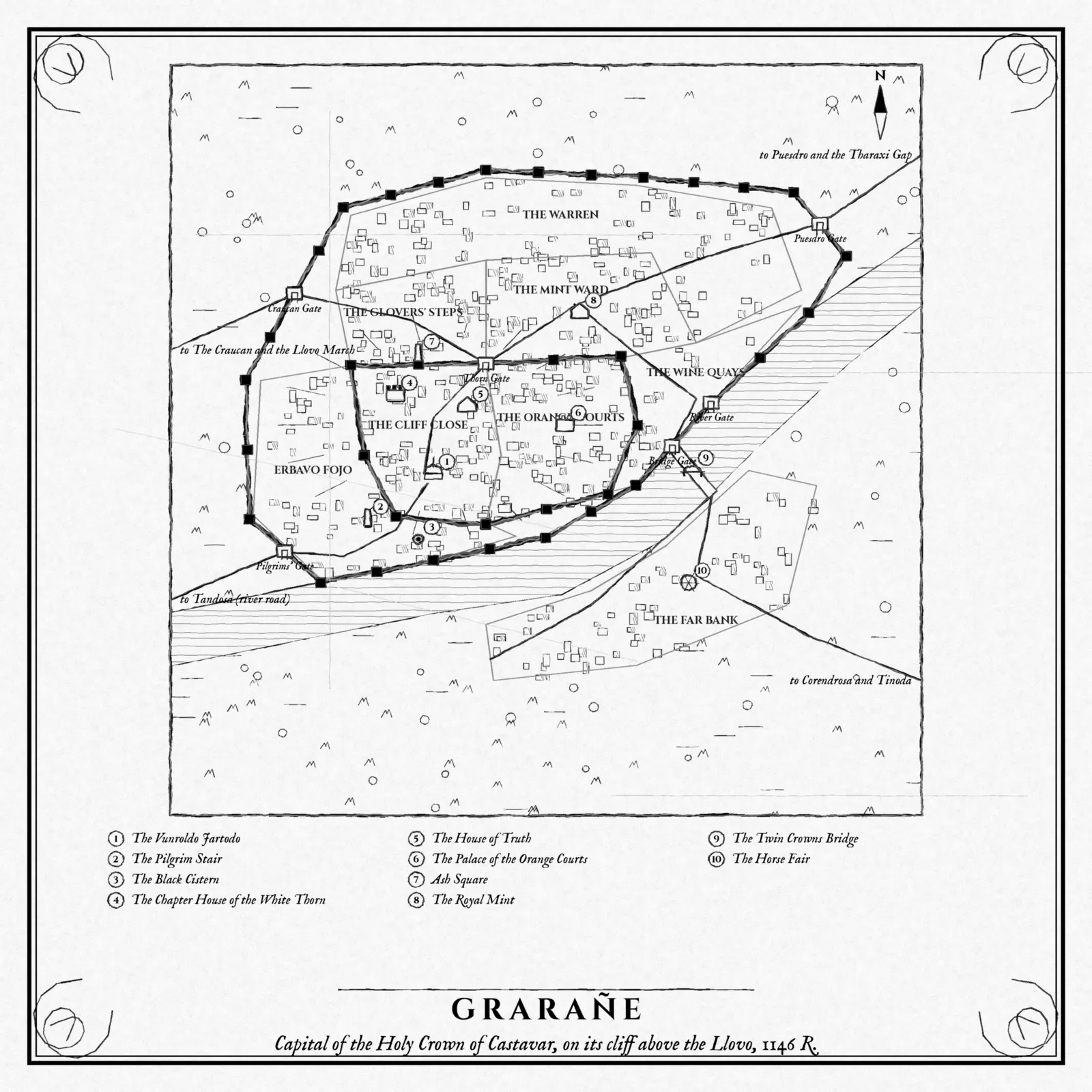
Capital of the Holy Crown of Castavar · about 70,000 people
Come up the Llovo from the west and you see the cliff first. It rises out of the cork-oak country, a wall of pale rock above a bend in the river, and on its summit stands the Vunroldo Jartodo, the cathedral-fortress, whitewashed so bright that at noon it hurts to look at. Storks stand on its towers. Below it the rock face is crusted with houses, chapels and cave-mouths, all joined by one zigzag stair, and at every hour of the day pilgrims climb that stair with their hats in their hands. The city's name is only the Castavari word for cliff, and nobody who has seen it asks why.
In summer the first sound is the cicadas in the cork oaks, loud enough to drown talk, and under them the cathedral bells. The first smell is thyme, dust and horse, because the western road passes the paddocks of the Craucan, and after that the sour smell of wine barges at the quays. On Fojiga, the seventh day of the Castavari week, the bells stop, the Berrode sings without music, and the city goes quiet in a way strangers find harder to bear than noise.
At a Glance
| Population | About 70,000 inside the walls and on the Far Bank; perhaps twice that in the Royal Demesne around it |
| Ruled by | King Dobarmo IV deso Grarañe, with the Grandees and the Rislo; in truth, Rislo Litoto |
| Walls | A whitewashed curtain wall around the north bank and an inner wall around the summit; the Far Bank is unwalled |
| Water | The Llovo below; rain cisterns and the Black Cistern above; water-mules on the stairs between |
| Lives on | Crown and church, the Royal Mint, wine, cork and wool from the Demesne, destriers from the Craucan, pilgrims |
| Faith | The Berrode of the Solitary God; the Grove of Lasdara in secret; a few followers of the Celestial Table |
| Tongues | Castavari; Caelvennois in the queen's household; Maved among the Qaflan |
| Coin | Gold larrama, silver jabirga |
| Known for | The Vunroldo Jartodo, Fojo's cliff and the Hearing, the Office of Truth, bitter oranges, the king's glove |
| Direction | CONTESTED |
History in Brief
- Before the Reckoning — The Builders cut a cistern into the cliff and line it with their black stone. It is still in use, and no one in the city knows who made it. (local lore)
- 0 R. — The Twin Crowns of Castavar and Lasdara sign the Accord of Surmave. House Grarañe has ruled Castavar since the Twin Crowns.
- 206–212 — King Clislo II marches 40,000 men up the Puesdro road to the Tharaxi Gap and is killed by a thrown spear at the Battle of the Gap.
- 301 — Lasdara's male line dies out, and Castavar swallows it.
- 312 — Fojo of the Llovo, a goatherd, climbs the cliff in a storm and comes down proclaiming the Solitary God. The Years of Grace begin, and within a generation the kings have taken up the faith and outlawed the older gods.
- 367 — The Lake Comet hangs over the world forty nights, and the Berrode calls it a warning and builds. The city says the cathedral's great tower dates from that year. (local lore)
- 655 — Cravio of Grarañe is raised as the first Rislo, with power equal to the king's in matters of faith.
- 701 — King Llelilo the Pious dies of thirst on the First Crusade, and fewer than five thousand of his 30,000 come home.
- 752 — Silver is found above Puesdro. Within thirty years Castavar mints more silver than every other realm together.
- 868 — King Mairo II is captured at the Salt Pans and ransomed for his weight in silver. The city says the ransom was weighed on the great scale of the Royal Mint. (local lore)
- 960 — The Berrode bans and burns the House of Learning's star tables, in Ash Square by the city's account. (local lore)
- 983 — Rislo Gronrovo imprisons King Janedo IV for heresy and rules through the king's twelve-year-old son for eleven years.
- 1135 — Under the Gilded Pact, Rorelle diol Valcroix, Prince Lourien's seventeen-year-old niece, marries Crown Prince Dobarmo.
- 1138 — King Randuo V dies. Dobarmo IV is crowned at 27, and Rislo Litoto preaches the Third Crusade at the coronation.
- 1139 — Talodin fire breaks the Third Crusade at Faashab-Talodin. Eight thousand Castavari burn or drown, the king comes home with a burned hand, and the debt to Caelvenne doubles.
- 1146 — Litoto preaches the Fourth Crusade in every cathedral in Castavar. Farisel has stopped lending.
The Layout
Grarañe stands on the north bank of the Llovo, where the river swings west around the end of a long limestone ridge.
Grarañe stands on the north bank of the Llovo, where the river swings west around the end of a long limestone ridge. The ridge ends in the cliff, which faces south and west over the water. The summit holds the cathedral-fortress and the palace inside their own wall. Below it the old town runs down the gentler northern and eastern slopes to the quays in steep stepped streets, and the outer wall wraps the whole north bank. One stone bridge crosses to the Far Bank and the road to Corendrosa and Tinoda. Rank in Grarañe is measured in height, and a merchant who buys a house one street higher gives a dinner to let it be known.
The Cliff Close. The western half of the summit belongs to the church: the Vunroldo Jartodo, the Rislo's residence, the House of Truth, and the chapter house of the Order of the White Thorn. Clergy, knights, scribes of the Berrode Script and their servants live here, and almost no one else. The Close is swept twice a day and smells of beeswax and cold stone. The Rislo's windows look across a narrow lane into the queen's garden in the Orange Courts, and both households have planted their hedges higher every year since 1138.
The Orange Courts. The eastern half of the summit is the palace of House Grarañe and the town houses of the Grandees who attend the king. Its whitewashed courtyards are planted with the bitter oranges that are the palace's pride, so in spring the summit smells of blossom, and in winter the servants boil the sour fruit with honey. The Jevarrie, the council of lords, meets in a long hall here when the king summons it. The queen's household keeps its own courtyard, speaks Caelvennois among itself, and is watched from three sides.
Erbavo Fojo. The cliff-quarter hangs on the rock face below the Close, from the river landing to the cathedral's foot. The name means "Saint Fojo," and the Berrode holds that this cliff is the cathedral's foundation. The quarter is one switchback stair with everything built off it: pilgrim hostels, chapels no bigger than a cart, candle stalls, cave shrines, and the houses of the porters and water-carriers who carry other people up. It smells of wax, sweat and mule. Halfway up is the ledge where Fojo is said to have stood, and a pilgrim who reaches it on the dawn after the Hearing is held to be forgiven the year's sins.
The Glovers' Steps. The stepped streets north of the summit wall are the middle town, crowded with the trades that serve church and court. Chandlers make the Berrode's candles from the wax of the thyme-hill bees, and scribes write letters and petitions in the Market Hand. The glovers make a glove for every Castavari burned in war, and since 1139 they have had more work than they can handle. Talk here is a little too quiet, because the Office of Truth's lay informers live on the same streets.
The Mint Ward. The northeastern slope holds the Royal Mint and the silversmiths, assayers, money-changers and clerks who live off it. Mule trains come down the Puesdro road with ingots from the Silverhead Mines. The counting-house of the House of Farisel stands here with its shutters half closed, and a Qaflan letter-house keeps a coin-bowl for the Road Spirit at its door. The ward rings all day with hammers striking coin.
The Wine Quays. The river bank below the Mint Ward is the capital's working port. Barges load Llovo red, oil, cork and wool for Tandosa and unload salted sardines and dried octopus. Coopers, cork-cutters and bargemen live over their warehouses, and the taverns stay open later than anywhere else in the city. Broad stone steps run down into the river so barges can load at any height of water, and by custom a blow struck with one foot in the water is not counted. The quays are the one place in Grarañe where a sailor will swear by the sea out loud.
The Warren. The poorest quarter covers the northern slope inside the curtain wall. Its adobe and rubble houses are stacked up the hillside and joined by passages so narrow that the quarter is named for the rock rabbits its people eat. Porters, washerwomen, skin-curers and the widows of the Third Crusade live here. It is the likeliest place in the city for a Grove mask to be hidden in a chimney, which is why the Office of Truth raids it at night.
The Far Bank. Across the bridge lies an unwalled suburb where the city meets the country. The Horse Fair is held here, and the Upland Shepherds pen their flocks here on the drove-road. Drovers' inns, farriers, saddlers and the cheapest brothels in the Demesne line the road south. People cross to the Far Bank to say things they would not say on the north bank.
Landmarks
The Vunroldo Jartodo. The name means "the holy cathedral-fortress," and it is both: the Berrode's mother church and the Rislo's seat, a mass of thick whitewashe…
The Vunroldo Jartodo. The name means "the holy cathedral-fortress," and it is both: the Berrode's mother church and the Rislo's seat, a mass of thick whitewashed walls, arrow slits and square towers on the cliff where Fojo had his First Hearing. The nave is plain, cold and very tall. White-thorn storks nest on every tower, and the cathedral priests count them each winter, because a stork that leaves a church tower before spring means the bishop has sinned.
The Pilgrim Stair. The stair of Erbavo Fojo climbs from the river landing to the cathedral's west door in forty-one turns. On the dawn after the Hearing it is packed from bottom to top. The Grove says Fojo was struck by lightning and the goat came down alone, and that telling is never heard on the stair.
The Palace of the Orange Courts. The palace is a ring of courtyards, not one building, and a visitor can walk an hour inside it without passing the same orange tree twice. The king wears his armor to prayers in its chapel. The oldest courtyard is said to be where the kings of the Twin Crowns held court.
The House of Truth. The Office of Truth keeps its files, cells and clerks in a windowless block in the Close. The files are written in a plain, simple hand so that lay informers can write them. Behind it lies a walled garden of roses and herbs, the best-kept in Grarañe, which Brother Talvo tends himself.
The Chapter House of the White Thorn. The mother house of the Order stands at the edge of the Close, a fortress inside the fortress, with a horse yard and a hawthorn grove. Squires keep the Thorn Vigil in that grove when a campaign musters at Grarañe, kneeling all night with a branch across their knees.
The Black Cistern. Under the cathedral, reached by a stair from Erbavo Fojo, lies a great cistern lined with smooth black stone that sweats in summer and never cracks. The Berrode says Fojo blessed it, and masons say no quarry in Castavar yields anything like it. It is Builder work, the black cast stone of the Age of Ruins.
Ash Square. The square at the foot of the Glovers' Steps is where the Office of Truth burns its condemned, and the paving is stained dark in a ring around the post. The Ashen, the hidden party that wants the Office reined in, were named by their enemies for ash like this.
The Royal Mint. The gold larrama and silver jabirga are struck in this squat, barred hall from the silver of Puesdro. Its great beam-scale hangs from the roof. The crown's accounts are kept in church numerals, and the assayers' true books are in ledger figures, which the Office of Truth calls "the heretic's arithmetic" and still needs.
The Twin Crowns Bridge. The only bridge at Grarañe has five stone arches and a gate-tower at each end, and the city says it is older than the Berrode. It closes at sunset, and anyone caught crossing by boat after dark is taken for a smuggler, a lover or a Masker.
The Horse Fair. On the Far Bank, destriers from the Craucan, Gap mules and road horses are shown on a beaten field by the river. A trained destrier is sold only with a Grandee's letter, and no Castavari buys a horse that balks at the ford below the fair, because a destrier that will not cross the Llovo carries a rider who will die in the Sunmaw.
Government, Law and the Watch
Grarañe has no rulers of its own apart from the crown, because it is the crown's own city.
Grarañe has no rulers of its own apart from the crown, because it is the crown's own city. The king rules it through his household, and the Grandees keep houses in the Orange Courts and vote him money in the Jevarrie when he calls it. In 1146 they are angrier than they have been in a century, since Litoto has proposed seizing their silver mines "for God" to pay for the Fourth Crusade. The Old Jevarrie party has begun to look for friends among the Crownmen of Grarañe, the old royal servants and the queen's household, who hold that the king should rule and the Rislo should pray. Dobarmo IV is its head in name and has never once led it.
The Rislo sits at the king's right hand with a veto over matters of faith, and he draws the bounds of faith wide. The king's court in the Orange Courts hears property, debt and violence. The church's courts in the Close hear sin, marriage, oaths and heresy, and heresy goes to the Office of Truth, which can take a prisoner from the king's own cells. Everyone remembers 983, when a Rislo imprisoned a king.
The watch is drawn from the ratorlon of the royal garrison, pikemen and crossbowmen who keep the gates, the bridge and the squares in pairs. They are well drilled, badly paid, and unwilling to enter the Warren after dark. Punishment follows rank. A laborer who steals is flogged in Ash Square, a masesben who steals is fined, and a Grandee who steals is invited to lend the king money.
Trade and Work
Grarañe makes less than it spends. It lives on the crown, the church, the pilgrims and the silver of Puesdro, which passes through the Royal Mint and leaves as coin.
Grarañe makes less than it spends. It lives on the crown, the church, the pilgrims and the silver of Puesdro, which passes through the Royal Mint and leaves as coin. Around that heart crowd the trades of court and church: chandlers, glovers, vestment embroiderers, armorers for the White Thorn, scribes and saddlers. The Demesne sends in wine, oil, cork, Grarañe merino wool and cork-hill hams, and the Wine Quays send them on to Tandosa. The markets are the Horse Fair, the Wool Market by the Craucan Gate, the fish and oil stalls on the quays, and the pilgrim trade on the stair, where anything that can be blessed is for sale. The Glovers' Guild is the most respected craft in the city and fitted the king's own glove. The Brotherhood of Porters is the largest, and it can stop the upper city by sitting down.
Everyday prices in Grarañe (1146): | Item | Price | |---|---| | A day's work as a porter or quay laborer | 1 jabirga | | Bed and supper at a Far Bank inn | 1 jabirga | | Six loaves of bread | 1 jabirga | | Four jugs of common Llovo red | 1 jabirga | | Three beeswax candles for the cathedral | 1 jabirga | | A letter written by a Market Hand scribe | half a jabirga | | A burned soldier's prayer glove, fitted | 2 jabirga | | A barrel of salted Tandosa sardines | 8 jabirga | | A whole cork-hill ham | 1 larrama | | A trained destrier from the Craucan | 200 larrama and a Grandee's letter |
Daily Life
The day begins before dawn with the bells and the first water-mules on the stair.
The day begins before dawn with the bells and the first water-mules on the stair. Trade is done by noon, because in summer the stone throws back the heat and the city shutters itself until evening. The evening walk on the terraces below the summit wall is when marriages are arranged, debts talked over, and informers take notes. Houses are whitewashed stone or adobe under red tile, built around a courtyard with a well or cistern-mouth, and the better ones keep a potted bitter orange. People eat bread, olive oil, rabbit, chickpeas, salted sardines and, when they can, cork-hill ham, and they drink Llovo red cut with water. They dress in dark wool and linen, and the pious wear black on Fojiga. Nearly every family has a man who came back from the Third Crusade, and a gloved hand at dinner draws no remark. The glove comes off only to pray. For amusement there are sermons, processions, horse-racing on the Far Bank, dice on the quays, and the gossip of the Orange Courts, which reaches the Warren within a day.
The city's year follows the church months: - Llusodo, the First Month. The bull-runs are held on the saints' days in the towns of the Llovo March, and half the young men of Grarañe walk west to run. The capital holds none of its own. - The Hearing, the night of the 6th of Fojiga. On the longest night the city keeps vigil in the dark, and at dawn the pilgrims climb the stair at Erbavo Fojo in a line that takes four hours to reach the top. The Rislo preaches to them from the west door. - Litota, the Eleventh Month. The month of penance allows no meat, no weddings, no bull-runs and no music on any day. Rislo Litoto took his name from it, and the Glovers' Steps say he never left it. - The Feast of Grace, the 30th of Besriete. Penance ends and the whole realm eats together. The palace opens its outer courtyards to the city and gives away hams and bitter-orange preserve. - The Twin Crowns' Day. On the fourth Accord Day the palace hangs the old banners of Castavar and Lasdara side by side from the summit wall, and the king rides through the city with only his household. (local custom)
Faith
Grarañe is the mother city of the Berrode of the Solitary God.
Grarañe is the mother city of the Berrode of the Solitary God. Its God is one, alone and silent, and the silence Fojo heard is the whole of His message. The faith is in the storks, the bells, the black dress on Fojiga and the Office of Truth's quiet streets. Nearly all the clergy can read, and most are of noble blood, and the cathedral school and the orders' colleges are the only places of learning in the city.
Other faiths live beneath. The Grove of Lasdara is strong in the Warren among families from the southern cork country. Sailors on the quays are Salt-Sworn and say so only to each other. The queen and a few scholars keep to the Celestial Table's banned star tables. Ember Pilgrims are burned here. The Ecclesiasts, who hold that the Rislo's will is God's will and the king is its sword, have the church, the orders, and the poor who love a fiery sermon. The Ashen, who want the Office reined in and the Grove left alone, are paid for by Queen Rorelle, and Brother Talvo has a file on them.
Crime and the Underside
The commonest crime in Grarañe is informing, which is not a crime.
The commonest crime in Grarañe is informing, which is not a crime. The Office of Truth pays for names, and neighbors settle grudges by giving them. The old wives say never to speak a heretic's name after dark, because the Office hears through the walls, and so does the heretic.
Real crime follows the silver. Coin-clippers shave jabirga in the Warren and pass them at the Horse Fair. Mint clerks sell copies of the ledger-figure books to Caelvennois agents. Smugglers bring star tables, Zarvani medicine and Caelvennois pamphlets upriver in wine barrels. Hemlock of the Llovo grows wild in the thickets below the city, and every poisoning is laid at the Office of Truth's door whether it did it or not. Caelvenne's Quiet Office keeps agents in the city, and in 1146 they are going quiet one by one.
People of Note
- King Dobarmo IV deso Grarañe (35): pious, brave in the field, unable to decide in council, and ruled by his Rislo; he wears a glove over the Talodin-fire scar on his right palm and takes it off to pray.
- Queen Rorelle diol Valcroix (28): Prince Lourien's niece and mother of the king's two sons, who reports to her uncle in a cipher the Office of Truth has not broken, and pays for the Ashen.
- Rislo Litoto (59): head of the Berrode and the true master of Castavar's dealings with other realms, who sleeps on a board and preaches the Fourth Crusade.
- Grand Master Arsoso Tirago of the White Thorn (53): the Order's commander, who believes the crusades are holy and cannot be won, and who will lead the Fourth.
- Brother Talvo (41): inquisitor of the Office of Truth and a gifted gardener, with a file on the Grove and one on the queen he has not yet opened.
- Binto the Weigher: assay-master of the Royal Mint, an exact, bald man of about fifty who keeps the crown's books in church numerals and his own in ledger figures. His name means "honest," and the Mint Ward finds that funny.
- Fenarje the Stair-Keeper: lay warden of the Pilgrim Stair, a crusade widow who counts the pilgrims, rents the hostels and knows who climbs at night. Her name means "quiet."
- His name means "wise."
- Gauque the Glover: master of the Glovers' Guild, who fitted the king's glove in 1139 and has fitted some four thousand since. He will talk about any hand in Castavar but the king's. His name means "warm."
Rumors and Story Hooks
- A Caelvennois wine-factor was found floating in the Black Cistern in Plune, the third of Roltien Aijal's agents in the city to go quiet this year.
- Binto the Weigher has been summoned to the Rislo three times this month with the mint's full accounts, and the Mint Ward believes Litoto is reckoning the cost of seizing the Grandees' mines.
- At the last service on Fojiga, the king took off his glove and did not put it back on until he reached the palace.
- A Dunmorrow wagon under heavy guard came down the Puesdro road and went straight into the chapter house of the White Thorn. The squires say it held plate armor and a note.
- A drunk navigator on the quays swore that the stone of the Black Cistern matches the black stone divers bring up from under Lake Surmave, and he was arrested before he could say it twice.
- The Office of Truth has raided four houses in the Warren for a mask that came up from the Lasdara country with a fourteen-year-old altar-server.
- A Castavari envoy came home from the Cinder Teeth with an empty silver chest and went to the Rislo, not the king.
- Fenarje the Stair-Keeper has let a man with a branded forehead sleep in an empty hostel on the stair, and has told no one.
Where It Is Going
CONTESTED. Grarañe is the mother city of a faith and the seat of a crown, and in 1146 the two are pulling opposite ways over the same silver.
CONTESTED. Grarañe is the mother city of a faith and the seat of a crown, and in 1146 the two are pulling opposite ways over the same silver. The Rislo wants a Fourth Crusade and has no money for it, because Farisel has closed the purse. His plan to seize the Grandees' mines is pushing the Old Jevarrie toward the queen's Crownmen. The queen serves her uncle, loves her husband and pays for the Ashen, and the king cannot decide. Every party keeps its house within a quarter-mile of the others on the same summit, and the city below is poorer, more gloved and more frightened than it was before 1139. If the crusade marches, Grarañe empties of men again. If the Grandees stop it, the Rislo will look for heretics to blame, and he will find them. The next year will settle who rules Castavar, the crown or the cliff.