


Tharxa
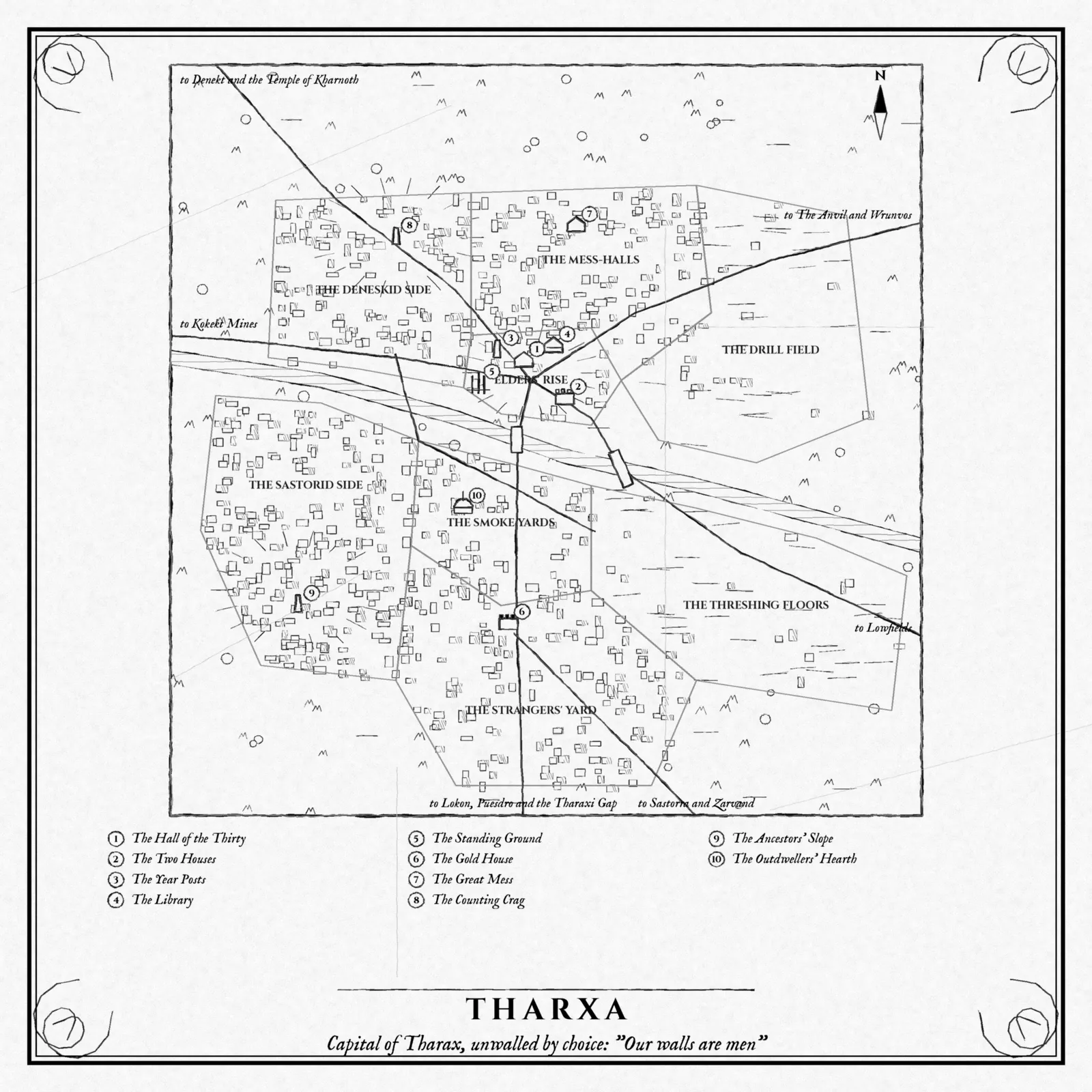
Capital of Tharax · about 35,000 people
The road climbs out of the Lowfields or comes down from the Wrunvos country, and the traveler waits for the wall that every capital has. It never comes. Barley terraces give way to goat-folds, goat-folds to plain stone houses, houses to long timber barracks halls, and he is in Tharxa without having passed a gate, a toll-post or a tower. The only thing that stops a stranger is a pair of young men in red cloaks standing at the roadside with spears. They look at him, say one word, and wait for his answer.
The next thing a visitor notices is the quiet. Tharxa has no bells and no street-criers, and its people do not raise their voices. The loudest sounds are a drill company crossing the Drill Field in step, whetstones, and goats. The air smells of pine smoke, wet wool, goat and baking barley. The Tharaxi say that a stranger who asks where the city's walls are has already seen them.
At a Glance
| Population | About 35,000: some 11,000 Phymun of all ages, 16,000 Bound, 7,000 Outdwellers, and a shifting thousand of foreigners in the Strangers' Yard |
| Ruled by | The two kings, Kenithor Deneskid and Lekakor Sastorid, checked by the Thirty and the five Skekar; 1146 is the year of Senior Skekir Sirtys Gonamik |
| Walls | None, by choice. "Our walls are men." |
| Water | The Barley Brook, which runs through the valley floor, and deep wells cut down through the pale ash band |
| Lives on | The court, the Thirty and the barracks; the barley terraces and goats of Tharxa Vale, worked by the Bound; Outdweller crafts; Kokekt iron; Caelvennois gold under the Iron Contract |
| Faith | Kharnoth the Unbroken and the Ancestors; the Furrow in secret among the Bound; the Hearthfaith, tolerated, among the Outdwellers |
| Tongues | Tharaxi; the Bound's field-talk (dasthax); Aldmeri, Castavari and Caelvennois in the Strangers' Yard |
| Coin | Iron bars (nisox) inside the city; foreign gold and silver belong to the realm and are changed at the Gold House |
| Known for | Having no walls; the seat of two kings; the Year Posts; the one small library; the finest foot soldiers alive drilling in its streets |
| Direction | CONTESTED |
History in Brief
- Before 0 R. — In the Century of Fire, Tharax loses half its citizens. The Phymun say Tharxa's old wall fell in that war and was never raised again (local lore; the Standing Ground is shown for it).
- 0 R. — Tharax signs the Accord of Surmave, the only signer that still stands under its own name. The list of named years begins.
- 0–146 R. — Tharax rebuilds the Anvil and says nothing to anyone.
- 199 — The First Bound Rising breaks out at harvest and is put down in eleven days. The Skekar found the Tyrthas. Tharxa has kept the Harvest Watch ever since.
- 212 — King Tothakhor Deneskid holds the Tharaxi Gap three days against 40,000. Every year since, the city's mess-halls have kept the Three Days in silence.
- 520 — The Second Bound Rising. King Drimor Sastorid is killed in his tent by a Bound servant. For a year after, no Bound servant may carry a knife inside Tharxa, and the rule was never lifted (local lore).
- 741 — The Skekar arrest King Phospor Deneskid for taking Caelvennois gold. He dies in prison. "Gold has a smell."
- 840 — Zarvand plants Faashab-Talodin on Tharaxi ground, and Tharax, weakened, lets it stand.
- 938 — "The quiet year": the Third Bound Rising is betrayed, and two thousand Bound are put to death in the Lowfields.
- 1052 — The Bridge Treaty leaves the Tharaxi Gap to Tharax and the Stair to Aldmere.
- 1108 — The Tharaxi Reforms let Outdwellers' sons into the Anvil. The Thirty split, and the quarrel of Deneskid and Sastorid begins.
- 1130 — Kenithor Deneskid and Lekakor Sastorid become kings within a year of each other.
- 1131 — Kenithor signs the Iron Contract; Lekakor loses the vote in the Thirty by two.
- 1137 — Khaasar Avisteer III's letter about the headwaters arrives in Tharxa. It is not answered.
- 1139 — The Third Crusade marches through the Gap under safe-conduct; Kenithor's forearm is broken by a bolt at Faashab-Talodin.
- 1145 — Lekakor asks the Thirty that Tharax leave the Iron Contract when its term ends in 1147. The vote is put off.
- 1146 — The year of Sirtys Gonamik. The city waits for the vote.
The Layout
Tharxa lies on the floor and both slopes of Tharxa Vale, where the Barley Brook comes down from the western heights and runs east-southeast toward the Lowfields.
Tharxa lies on the floor and both slopes of Tharxa Vale, where the Barley Brook comes down from the western heights and runs east-southeast toward the Lowfields. The old heart of it sits on a low rise north of the brook, and the city spreads from there in terraces, never tidy and never bounded. Six roads leave it: northwest to Denekt and the Temple of Kharnoth, west to the Kokekt Mines, east-northeast to the Anvil and on to Aldmere's Wrunvos, east-southeast to Lowfields, south to Lokon and the Gap, and south-southeast to Sastorra and Zarvand. Where each road passes the last house the Road Watch stands, and in peacetime that is the whole of the city's defense.
Elders' Rise. The low hill at the center holds the rule of the realm and nothing else: the Hall of the Thirty, the Two Houses of the kings, the Year Posts and the library, set around a bare gravel yard ringed by the black footings of the Standing Ground. The Two Houses stand close enough for one king to see who knocks at the other's door.
The Deneskid Side. The northwest slope, climbing toward the Counting Crag and the Denekt road, is where the households of the Deneskid line and its friends have always lived. The houses are stone below and timber above, each with a walled goat-yard, and each is run by its Phymon women, who own the ground it stands on. The sounds of its streets are the handmill, the loom and the goat. Many houses hang an eagle feather over the inner door, a habit taken from the royal burials.
The Sastorid Side. The southwest slope, facing the Gap road, belongs by the same custom to the Sastorid households. It is newer, busier and poorer in stone, and since 1108 some Sastorid women have let lower rooms to Outdweller families, which the Deneskid Side calls a scandal. The Ancestors' Slope lies along its upper edge, and Krirtys Sastorid runs the path past the graves every dawn.
The Mess-Halls. The northeast quarter is a grid of long pine barracks and daipox, the mess-halls where Phymon men eat together. Men under thirty sleep here, not at home. Inside each hall are a table the length of the room, benches, spear-racks, and a chair left empty for Kharnoth. The quarter smells of barley broth and wet cloaks, and on dakt, the tenth day, when every hall eats at once, three thousand men eat without a word.
The Drill Field. Along the north bank of the brook east of the Mess-Halls lies the beaten ground where the city's companies drill every day, and where the grass never comes back. Sheds at its east end hold the cart-mounted ballistae. Boys of seven walk out the east road past this field on their way to the Anvil. A mother walks her son to the field's edge and no farther.
The Smoke Yards. South of the brook and below the Rise, the Outdwellers work: smithies turning Kokekt iron into tools, nails and the city's money, tanners, shield-facers, turners of Karzhan pine spear-shafts, and dyers whose ibex-lichen vats stain the lower brook orange. Forge smoke hangs in the valley on still days. The quarter is louder than the rest of Tharxa, which the Phymun take as proof of what they think of trade.
The Strangers' Yard. Where the Lokon and Sastorra roads leave the city stands the one place built for foreigners: a walled square of inns, mule yards and warehouses, and the only walled ground in the capital, which the Phymun find funny. Qaflan caravans, Gap Wardens' mule trains, Aldmeri wool buyers, Dunmorrow steel factors and, in quiet years, Castavari traders from Puesdro all deal here. By law no foreigner may sleep in Tharxa outside the Yard, and the Tharaxi think that a fair answer to Solvaine.
The Threshing Floors. The low ground east of the Smoke Yards is the Bound quarter: stone threshing floors, barley granaries, goat byres and fieldstone huts. It is the most crowded part of the city and the most closely watched. The Tyrthas keeps no building here, and that is how everyone knows it is present. The Warning Posts stand at its edge, and in the Harvest Watch the smell of threshed barley lies over the valley while the Phymun sleep armed in the halls above.
Landmarks
The Hall of the Thirty. The Thirty meet in a long, low hall of gray stone with one door and no windows on the street.
The Hall of the Thirty. The Thirty meet in a long, low hall of gray stone with one door and no windows on the street. Thirty stools stand in a ring on the bare floor, with a bench for the five Skekar and two plain chairs for the kings. Here they sit as council and court, and here they serve as Kharnoth's priests. The vote on the Iron Contract, when it comes, will be taken in this room.
The Two Houses. The kings live in two stone houses alike in every way, facing each other across a yard of ten paces, the Deneskid house to the north and the Sastorid house to the south. Neither is larger than a well-off Phymon household. Each king's guard watches the other king's door. The Tharaxi say you can read the state of the realm by whether both doors are ever open at once.
The Year Posts. A double row of pine posts carries, in Spearmarks, the name of every senior skekir since the Accord, ten years to a post; rotten posts are recut and the names copied over. The newest name is Sirtys Gonamik's, and old Phymun note that it stands on the recent posts more often than any name in living memory. Every Tharaxi child is brought here to find the year of the Battle of the Gap.
The Library. Tharax's one small library is a single stone room behind the Hall of the Thirty. It holds scrolls on war, the passes, the named years, treaties in their foreign copies, and a few Zarvani books of physic taken in war. Krirtys Sastorid has read it twice. Most Phymun have never been inside.
The Standing Ground. A ring of black cast-stone footings, smooth, sharp-edged and harder than anything a Tharaxi mason can cut, runs along the edge of Elders' Rise. The Phymun hold that the old wall stood here, and that when it fell Kharnoth, then a mortal captain, stood his men in a line on this spot and said, "Now we are the wall." The ground inside is never built on. Recruits stand a night's watch here before they leave for the garrisons, and one stone is cut with Khern moxik, brex, "Our walls are men." The same black stone lies under half the great cities of Aethorra, and no one in Tharxa has asked where it came from.
The Gold House. At the gate of the Strangers' Yard stands the only building in Tharxa with an iron door. It holds the realm's foreign gold and silver, the Iron Contract's gold among it, which Caelvenne pays each New Year's Day, and every foreigner must change his coin here for iron bars. The door has three locks, with one key for each king and one for the senior skekir. The Phymun call it "the Smell."
The Great Mess. The largest mess-hall in the city seats six hundred. Both kings eat here on dakt with whatever companies are in the city, on the same bread as everyone else. Its empty chair is said to be the oldest in Tharax, and the Skekar choose the Bound who clear its plate.
The Counting Crag. A bare knob of rock with a stone bench above the Deneskid Side gives the best view of the sky. Old Phymun sit here watching the Karzhan eagles ride the valley's updrafts, because an eagle circling Tharxa three times means a king will die, and twice means a king will lie. They count aloud and argue over what counts as a circle.
The Ancestors' Slope. The Phymun bury their dead in rows facing the city, each with an iron bar in his hand so he will have money in the next world, where it will be worthless too. Kings lie at the top with a Karzhan eagle feather. A small bare temple of the Ancestors stands at the foot of the rows, and Phymun stand in it before a campaign so the dead will know whom to stand behind.
The Outdwellers' Hearth. In a plain timber hall in the Smoke Yards the Outdwellers keep the Hearthfaith, tolerated because the Phymun do not care about foreign gods. It has one fire and no priest. The eldest smith tends it.
The Anvil (beyond the city). Tharax's training grounds and barracks lie east of Tharxa along the Wrunvos road. Every Phymon boy goes there at seven and is branded on the shoulder with a spear-point, without a sound. Since 1108, Outdwellers' sons from the Smoke Yards have gone too.
The Temple of Kharnoth (beyond the city). Northwest of Tharxa in the Deneskid Heights stands the bare temple of Kharnoth the Unbroken, served by the Thirty. Companies leaving by the Denekt road stop there on the way.
Government, Law and the Watch
Tharxa has no mayor or governor, because the rule of all Tharax sits in it.
Tharxa has no mayor or governor, because the rule of all Tharax sits in it. The two kings lead in war and share the ruling. The Thirty, elders over sixty, decide the realm's great matters, judge cases of life and death, and serve as Kharnoth's priests. The five Skekar, chosen each year and seated on Wardens' Day, oversee everything else, the streets included, and can arrest a king. The senior skekir names the year. In 1146 that is Sirtys Gonamik, who also heads the Tyrthas.
Among the Phymun, order is kept by the Road Watch, drawn from the mess-halls in turn, one hall to each ten days. It stands at the road-heads and brings quarrels to the Skekar. Outdwellers answer to the Skekar through the eldest of each craft yard. The Bound answer to the Tyrthas, which in Tharxa means to no one they can see. A foreigner found asleep outside the Strangers' Yard is walked back the first time and thrown out of Tharax the second.
Punishment is quick and public. A Phymon who shames his hall eats standing for a set number of tens. A Phymon found holding gold is tried by the Thirty, because gold has a smell. A Bound man who reads, keeps the Furrow or strikes a Phymon is hanged, and his body is left on the Warning Posts.
Trade and Work
The Phymun despise trade, so Tharxa trades through others.
The Phymun despise trade, so Tharxa trades through others. Phymon women own most of the Vale and keep its accounts on tally-boards, which are not held to be writing. The Bound farm, herd, thresh, carry and cook. The Outdwellers make everything else.
There are no guilds. Each craft keeps its own yard in the Smoke Yards, and the chief of them is the Bar Forge, the only place in Tharax where iron bars may be cast. A bar of Kokekt iron is about a forearm long and scored in ten so it can be snapped for small change, and a man carries his wages in a sack. Other yards make tools, nails, harness, shield-rims, spear-shafts, red cloaks and ballista carts. Steel for spear-points and breastplates is bought from the Dunmorrow with the realm's gold.
The Strangers' Yard is the city's one market. It sells salt, Dunmorrow steel, Aldmeri wool and grain in bad years, Gap mules, wine for foreigners, and Qaflan news. Tharax sells coarse Spine wool, hides, goat cheese, Kokekt iron, Gap falcons and, above all, its spears.
| Everyday prices in Tharxa | Iron bars |
|---|---|
| A loaf of black barley bread | a tenth |
| A jug of ale in the Strangers' Yard | a tenth |
| A round of goat cheese | two tenths |
| A night's bed and supper in the Yard | half a bar |
| A turned Karzhan pine spear-shaft | 2 |
| A pair of hobnailed boots | 3 |
| A red ibex-lichen cloak | 8 |
| A Spine sheep | 12 |
| A trained Gap falcon | 40 |
| A Gap mule | 60 |
Daily Life
Phymon men eat in the mess-halls: black barley bread, mutton-and-barley broth with Anvil thyme, goat cheese and Spine sheep, and snow grouse, Kokekt char and he…
Phymon men eat in the mess-halls: black barley bread, mutton-and-barley broth with Anvil thyme, goat cheese and Spine sheep, and snow grouse, Kokekt char and headwater trout in season. They drink ale; wine is for foreigners. Phymon men wear red cloaks dyed with ibex-lichen, women wear them at feasts, and no one wears gold. Every Phymon carries the spear-point brand on the shoulder, and every Bound a plain bar on the back of the neck. Brides wear crag edelweiss. Houses have stone ground floors, timber above, and pine-shingle roofs weighted with stones. The Bound live in fieldstone huts or in the back rooms of the houses they serve.
The companies are on the Drill Field before the sun clears the eastern ridge, and the Bound are on the terraces. At dusk the men go to the mess-halls, the women count the day's work at home, and the Counting Crag fills with old men watching the sky. The week is a ten of numbered days, kaim to dakt. For sport Tharxa runs, wrestles, throws the javelin, hunts with Gap falcons and tells tales: the Boy Who Would Not Cry in the halls, the Skekir's Wife among the women (the men laugh at it carefully), and Gonam's Fox among the Bound, who hear it as a tale about the Tyrthas. A Phymon mother pinches her infant when it smiles, because a child who laughs before one will not live through the Anvil.
Festivals. - Wardens' Day (1st of Lokok, New Year's Day). The new Skekar take their seats, the year takes its name, and a new name is cut on the Year Posts. Caelvenne's envoy hands over the Contract's gold the same day, which the Phymun feel spoils it. - The Three Days (10th to 12th of Xert). For the Battle of the Gap in 212, every mess-hall keeps silence at meals for three days and speaks the names of the dead on the third. - The Harvest Watch (all of Tandox). Since the First Bound Rising of 199, the Phymun sleep armed the whole harvest month while the Bound bring the harvest in. - The Empty Chair (every feast). A chair and a full plate are left for Kharnoth, and the Bound, who have their own name for the chair, clear it.
Faith
Kharnoth the Unbroken and the Ancestors are worshiped without clergy.
Kharnoth the Unbroken and the Ancestors are worshiped without clergy. The Thirty are the priests, the Hall of the Thirty serves as Kharnoth's house in the city, and worship is done in the line: a night on the Standing Ground, the Empty Chair, a visit to the Ancestors' Slope before a campaign. The Phymun believe the honored dead stand behind the living, and that the last man in any line who does not step back is, for that moment, Kharnoth.
Beneath this runs the Furrow, which holds that the earth is a sleeping mother and Kharnoth a thief who stole the mountains. Its only mark is a curved line scratched under tools, on doorposts and on forearms, and its holy women, the Sowers, are always old, because the Tyrthas looks least at old women. To keep it is a hanging crime. The Outdwellers keep the Hearthfaith, and the Phymun ignore it, as they ignore the odd Ember Pilgrim in the Strangers' Yard.
Crime and the Underside
A city where every grown man is a soldier and money is too heavy to steal quietly breeds few pickpockets.
A city where every grown man is a soldier and money is too heavy to steal quietly breeds few pickpockets. Tharxa's crimes are of other kinds. Foreign coin that should reach the Gold House sometimes does not: Outdweller traders keep hoards of jabirga and Aldmeri marks under their floors to buy what iron cannot, and a few Phymon households are whispered to do the same. Bound runaways leave by night for the Stair, where the Stairfolk guide anyone who can pay and the Charter of Hearths makes a Bound man free on Aldmere soil. The Tyrthas hunts them. It hunts the furrow-mark too, and the reader, and the man who meets too many others after dark, and stonebane is said to be its tool when a death must look like fever. And Caelvenne's Quiet Office keeps agents in Tharxa, which is supposed to be impossible. They are likelier to be Outdwellers than foreigners.
People of Note
- King Kenithor Deneskid (44). The best field commander alive, who signed the Iron Contract and carries the shame of it; the north house is his.
- King Lekakor Sastorid (38). Wants out of the Contract and more Outdwellers' sons in the Anvil; sleeps four hours a night in the south house.
- Skekir Sirtys Gonamik (58). Senior Skekir, head of the Tyrthas and the name of the year, with a limp from the Kokekt mines.
- Krirtys Sastorid (17). Lekakor's Anvil-branded daughter, who has read the library twice and wants to stand in the line.
- Tandox the Bound (29). A Lowfields man, but his band is the one thing the Tyrthas in Tharxa has not found.
- Roltien Aijal. Master of Caelvenne's Quiet Office, who has never set foot in Tharxa and knows what is said in it.
- Konpax the Keeper. A one-eyed Phymon past seventy who keeps the library, recuts the rotten Year Posts, and does not see Krirtys borrowing scrolls at night.
- Sithaks the Tally-Keeper. A Phymon widow of the Sastorid Side who keeps the Gold House tally and knows to the coin how long the gold would last without the Contract.
- Dunox the Barsmith. The Outdweller master of the Bar Forge, who makes Tharax's money and cannot use it as a citizen does. His second son is in the Anvil under the reforms of 1108.
- Thantak of the Road Watch. A Phymon of twenty-four whose hall has the watch this ten; loyal to Kenithor, and keeping a list of foreigners who ask about the Gold House keys.
- Phorirk the Cook. A gray Bound woman who has cleared Kharnoth's plate at the Great Mess for thirty years and is never looked at twice, which is what the Furrow wants from an old woman.
Rumors and Story Hooks
- The envoy who brought the Contract's gold on Wardens' Day carried a private letter offering Lekakor double for the Tsanha fords. Thantak saw the envoy cross to the south house after dark and has told no one yet.
- Sithaks's tally says the Gold House can buy Dunmorrow steel for three more years without the Contract. The Thirty have not asked her.
- The old men on the Counting Crag swear an eagle circled the city twice on the day the Contract vote was put off, and they are arguing over which king lied.
- A thresher found a furrow scratched under a bench in the Great Mess. Phorirk the Cook has already put the bench on the fire.
- Dunox's son is one of the two young Phymun sent into the high woods after a Karzhan bear, and the Smoke Yards are waiting to see who comes back.
- Krirtys Sastorid has been seen standing a night alone on the Standing Ground, which only men bound for the line do.
- A Zarvani physician in the Strangers' Yard has been asking the Bar Forge smiths how much stone it would take to dam a mountain stream. He may be Prince Faasheer's man.
- A well-digger on the Sastorid Side cut through a yard of pale ash and struck a floor of the same black stone as the Standing Ground. Konpax told him to fill it in and say nothing.
- Someone is sending the Thirty's count of heads to Caelvenne before each vote. The Tharaxi blame a foreigner. More likely it is someone with a key to a door on Elders' Rise.
Where It Is Going
CONTESTED. Tharxa's quiet is the quiet of a city waiting for a vote.
CONTESTED. Tharxa's quiet is the quiet of a city waiting for a vote. The Iron Contract's gold has paid for its steel since 1131 and runs out in 1147, and the two kings who live ten paces apart want different things from its ending: Kenithor to be free of the shame, Lekakor to be free of the gold and to open the Anvil wider so the ranks of citizens stop shrinking. The Thirty lean toward the Old Anvil; the young men of the halls lean toward the Wide Anvil; both kings and most of the army are Iron-Breakers. Under all of it lie sixteen thousand Bound in the Threshing Floors and a band in the Lowfields that the Tyrthas has not found. A city with no walls stands only as long as its men agree where to stand, and in 1146 Tharxa's men do not agree.